What is an AI database schema generator?
An AI database schema generator is a tool that uses artificial intelligence to design and structure a database automatically. The system analyzes raw input and generates a schema based on its detectable patterns and relationships.
What sets these tools apart is their ability to understand context. With machine learning and NLP, these tools detect structure, model relationships, and generate schemas that reflect real-world data usage patterns.
For example, a retail company could upload customer and order logs and, within minutes, generate a relational schema that captures purchasing behavior, regional trends, and product-level metadata. Instead of spending days mapping this manually, the team gets an intelligent structure tailored to real usage—ready to scale or integrate with analytics tools.
But to appreciate the value of AI-generated schemas, you first need to understand why schema design matters.
Why database schema design matters
Most application failures don't start with lousy code—they start with a bad schema. If the foundation is flawed, no amount of engineering talent or cloud infrastructure will save you from bottlenecks, bugs, and breakdowns.
Here's what great schema design delivers:
- Speed where it counts – Indexes and well-structured relationships make queries fast. Poor schemas turn every data request into a performance hit.
- Data integrity at the foundation – Tables, columns, keys, and constraints aren't just structures but safeguards. They prevent duplication, enforce logic, and keep your data clean.
- Scalability without technical debt – A solid schema scales cleanly. A fragile one leads to patchwork fixes, bloated tables, and constant rework as your system grows.
- Clear logic, fewer bugs – A well-structured schema maps closely to business logic. That means developers spend less time decoding data and more time shipping code that works.
- Faster analytics, better decisions – Clean schemas enable clean data pipelines. If the structure is flawed, your dashboards are too.
The cost of a poor schema doesn't show up on Day 1, but it adds up fast—query times slow down, bugs multiply, and scaling breaks things. And when it surfaces, it's already embedded deep in your system.
That's why schema design—whether manual or AI-assisted—is foundational. While not schema generators, most tools, like dbForge AI Assistant, support the broader workflow by helping developers write and optimize SQL in the context of an existing database structure.
Traditional vs AI-driven schema design
The way we design databases is being rewritten. What once took days of planning, diagramming, and iteration can now be done in minutes with AI. But how do traditional and AI-driven approaches compare?
Traditional schema design is manual, slow, and brittle. It relies heavily on human memory, technical guesswork, and hours of upfront effort. By the time it ships, the structure often lags behind the pace of the product. It wasn't built for real-time data, fast-moving teams, or AI-native systems.
AI-driven schema design doesn't just improve the old model—it replaces it. It reads your data, understands your intent, and generates a structure built for speed, scale, and change. No guesswork. No bottlenecks. Just smarter design from the start.
Traditional vs AI-driven schema design comparison table
| Aspect | Traditional schema design | AI-driven schema design |
|---|---|---|
| Approach | Manual design by developers or DBAs | Automated suggestions based on data analysis and patterns |
| Time investment | High – requires careful planning and iteration | Low – rapid generation based on existing data or context |
| Error risk | Prone to human error in structure or relationships | Reduces risk with logic-based validation and consistency |
| Scalability | Challenging in large, complex environments | Adapts better to growing or fragmented data sources |
| Skill requirements | Requires strong database modeling expertise | Teams with limited database modeling experience can use it, though expert review may still be required. |
| Adaptability | Changes require manual rework | AI can adjust schemas based on new data or context changes |
| Data source handling | Often limited to structured, predefined sources | Works with structured and semi-structured data formats |
| Use in agile environments | Slower iteration, not ideal for rapid prototyping | Supports fast iterations and frequent schema updates |
| Integration with AI/LLMs | Manual schema mapping needed | Designed to support LLMs and context-aware data access |
The verdict is simple: AI-driven schema generation is not just the future—it's already the standard for teams building at scale. But what makes these tools function—and how do they generate structure from raw inputs?
How AI database schema generators work
An AI schema generator does not guess—it extracts structure from data with precision. This is not magic—it's pattern recognition, statistical modeling, and NLP working in tandem. Let's explore this in detail.
Data ingestion and pattern recognition
It starts with ingestion. CSVs, JSON files, and even unstructured documents—all go in. The AI parses the content, detects recurring patterns, and identifies likely entities, attributes, and keys. It recognizes what belongs together and what doesn't.
Fields like user_id, email, and created_at aren't just seen as strings—they're interpreted as identifiers, timestamps, or relationships. That's where traditional rule-based tools fall short—AI sees the shape and the intent behind the data.
Schema inference and generation
Once the structure is clear, the generator builds the schema. It recommends tables, columns, data types, and constraints based not on templates but actual data behavior. Relationships are mapped. Keys are assigned. Data types are inferred.
It's not guesswork. It's statistical modeling, refined through exposure to thousands of schema patterns. The output? A complete, production-ready schema—generated in minutes. Once generated, tools like dbForge AI Assistant can help developers interact with these schemas more efficiently—writing, explaining, and optimizing queries with context-aware assistance.
Use of machine learning and NLP
This level of understanding comes from machine learning models trained on vast datasets and improved through feedback loops. Natural language processing (NLP) adds another edge, allowing the system to interpret business terms and human-written descriptions.
Whether the input is a technical data dump or a paragraph like “Each order includes multiple items, and every customer has a unique ID,” the AI can generate a schema that aligns with the data's structure and semantics. Developers actively explore this type of functionality in forums like r/AskProgramming, where discussions revolve around using machine learning to infer database logic from real-world inputs.
These capabilities translate into powerful features designed to meet real-world data challenges.
Key features of AI schema generator tools
AI schema generators are built for more than speed—they're designed for precision, flexibility, and scale. Let's explore their features in detail.
Automatic relationship mapping
Manually defining relationships is tedious and error-prone. AI tools automate this process by analyzing data patterns, identifying shared keys, and mapping out one-to-one, one-to-many, and many-to-many relationships precisely. They analyze identifiers and usage patterns to define relationships as they actually exist in the data.
Support for multiple data formats
Modern data doesn't live in one format and doesn't come clean. It's coming in from APIs, spreadsheets, logs, third-party platforms—often all at once. AI schema generators are built to handle structured inputs like SQL and CSV, semi-structured data like JSON or XML, and even natural language. Instead of forcing data into predefined molds, these tools adapt to your sources—parsing and normalizing them into a unified, usable structure.
Custom rules and constraints integration
While AI handles the heavy lifting, control stays with the team. The best tools allow users to layer in custom business logic: unique constraints, validation rules, and field-specific conditions that reflect real-world application requirements. This blend of automation and customization ensures the schema doesn't just match the data—it matches the business behind it. In fact, a developer on r/rails recently shared an AI-powered schema assistant project and received feedback on exactly this balance.
Pro tip: Tools like dbForge offer visual schema modeling and rule integration, helping teams refine AI-generated structures with manual control where needed.
Benefits of using AI for schema generation
AI-driven schema generation is how modern teams escape the overhead of legacy architecture and focus on what moves the business forward.
Here's what AI brings to the table—and why teams that adopt it aren't looking back.
Velocity that compounds
AI doesn't shave minutes off your workflow—it removes days from your roadmap. Schemas are generated in minutes, reviewed in hours, and deployed on the same day. Multiply that across sprints, teams, and products—and you get a speed advantage your competitors can't match.
Consistency you can trust in production
Most teams don't notice structural errors until something breaks—an index missing, a key misaligned, or a field duplicated across tables. Manual design increases the risk of these problems over time, but AI stops them before they start.
It applies logic, enforces structure, and doesn't forget the edge cases. The result? Data models that hold up under growth, change, and load—without constant firefighting.
Built-in flexibility for real-world change
Traditional schemas resist change, but AI models are built to adapt as business logic shifts, data evolves, and new sources emerge.
Whether you're onboarding a new integration, reshaping a product, or scaling to new use cases, AI-generated schemas flex without friction. There is no teardown or rebuild—just continuous alignment between your data structure and your business reality.
How dbForge AI Assistant puts schema intelligence to work
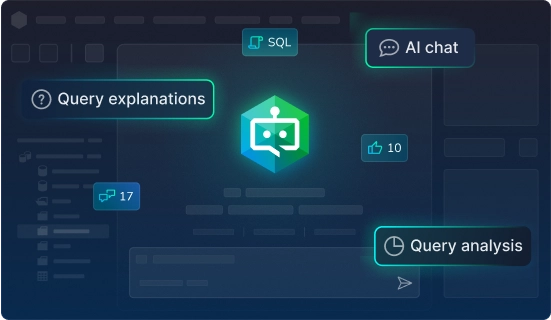
Manual query design, debugging, and optimization take time and can slow teams down when speed matters most. dbForge AI Assistant introduces features to ease this process by offering schema-aware SQL generation, explanations, and basic optimization—all integrated into the developer workflow. Here's how it works in practice:
- Context-Aware Coding – Generates optimized SQL by analyzing schema structure—no need to access underlying data.
- Natural Language to SQL – Turns plain language inputs into executable queries, letting you convert text to SQL and making queries more accessible to non-technical users.
- SQL Troubleshooting – Identifies errors or inefficiencies and offers fixes with clear reasoning.
- Query Explanations – Breaks down each part of a query to help developers and learners understand how it works.
- SQL Optimization – Rewrites underperforming queries and recommends improvements based on usage patterns, offering an advanced AI SQL query optimizer.
- Error Analysis – Diagnoses SQL issues during execution and provides actionable solutions.
- AI Chat – Offers real-time assistance within the IDE for usage tips, troubleshooting, and query guidance.
- IDE Integration – Supports code and visual editors, streamlining query writing and schema-aware development.
This release also includes enhanced support for cloud database platforms, helping teams build and scale in distributed environments with fewer manual bottlenecks. Try dbForge AI Assistant and experience firsthand how it can accelerate your SQL development process.
Conclusion
Manual schema design wasn't built for the systems we're building today. It's too slow, brittle, and dependent on people catching mistakes before they become failures. AI schema generation changes the terms entirely. It replaces human guesswork with data-driven precision. It scales without rework. It adapts as your systems evolve. And it does all of that in real time.
The teams building fast, confidently scaling, and deploying AI-native systems already rely on intelligent schema generation. AI schema generation isn't the future—it's the new baseline for building systems that scale.
FAQ
Several tools support AI-powered schema generation, though not all are explicitly branded as “AI tools.” Examples include:
- Devart's dbForge Studio: While not marketed as an AI tool, it offers intelligent features like automated code generation, smart suggestions, and visual modeling that align with AI-driven workflows.
- Retool AI: Allows users to generate SQL schemas and queries from natural language prompts.
- ChatGPT-based integrations: Developers can use ChatGPT plugins or APIs to create schema drafts based on data descriptions or example records.
- Low-code platforms like Appsmith and OutSystems: They offer AI-assisted schema suggestions during application development and data modeling.
A generative AI tool is a machine learning system trained to create structured outputs—like text, code, or database schemas—based on patterns in input data. In schema generation, it builds data models from raw or semi-structured inputs with minimal human input.
The tool processes inputs such as CSV files, JSON, and plain language descriptions using machine learning and NLP. Based on the data's content and context, it infers logical structure—suggesting tables, relationships, field types, and constraints.
Yes—schema generator AI tools are well-suited for enterprise environments. They can process large, complex datasets from multiple sources, infer relationships, and generate scalable schemas that align with enterprise-grade architecture. Many also support customization, governance rules, and integration with CI/CD pipelines, making them practical for high-compliance and large-scale systems.