ADO.NET Provider for Salesforce with Entity Framework and SSIS Support
dotConnect for Salesforce is an ADO.NET provider for accessing data of the Salesforce.com
cloud CRM and Database.com cloud database through the standard ADO.NET or
Entity Framework interfaces. It allows you to easily integrate Salesforce data into
your .NET applications, and integrate Salesforce services with widely used data-oriented
technologies. dotConnect for Salesforce offers local SQL engine to query Salesforce
data, advanced data caching, query optimization and other enterprise level features.

dotConnect for Salesforce eliminates the need to learn complex Web Services API
- it allows you to use your knowledge of ADO.NET and Entity Framework.
dotConnect for Salesforce offers the easiest way for integration of Salesforce services
into .NET applications and the highest performance. It uses advanced data caching,
connection pooling, and query optimization to increase the performance of connecting
to Salesforce CRM and fetching data.
Its local SQL engine allows you to use SQL-92 compatible SELECT statements to work
with Salesforce Leads, Contacts, Opportunities, Accounts and other objects in the
same way as with SQL tables. You may use complex JOINs, WHERE conditions, etc. -
all the SQL benefits, not available with Salesforce SOQL.
dotConnect for Salesforce Benefits
-
Use your knowledge of SQL-92, ADO.NET, and Entity Framework with Salesforce data!
-
Integrate Salesforce data with Microsoft data access technologies!
-
Use our enterprise level features, such as data caching for offline work, connection
pooling, and connection failover!
ADO.NET
ADO.NET is a widely-used and well known way to access data that can easily be integrated
with a number of data processing technologies, thus allowing you to easily create
data-oriented applications.
Our ADO.NET provider offers you:
- Powerful local SQL engine with support
for SQL-92 compliant SELECT statement
- Visual Studio integration - data binding, Server
Explorer, Query Builder, Data Source Configuration Wizard, etc.
- Easy access to metadata with either GetSchema method or through SQL-92 compatible
information schema
Entity Framework
Entity Framework offers a number of advantages over using Salesforce developer API
directly:
- LINQ to Entities (no need for Salesforce SOQL)
- Entity relations with lazy/eager loading
- No need to post each edited/created object separately - a single SaveChanges()
call to persist all the changed objects
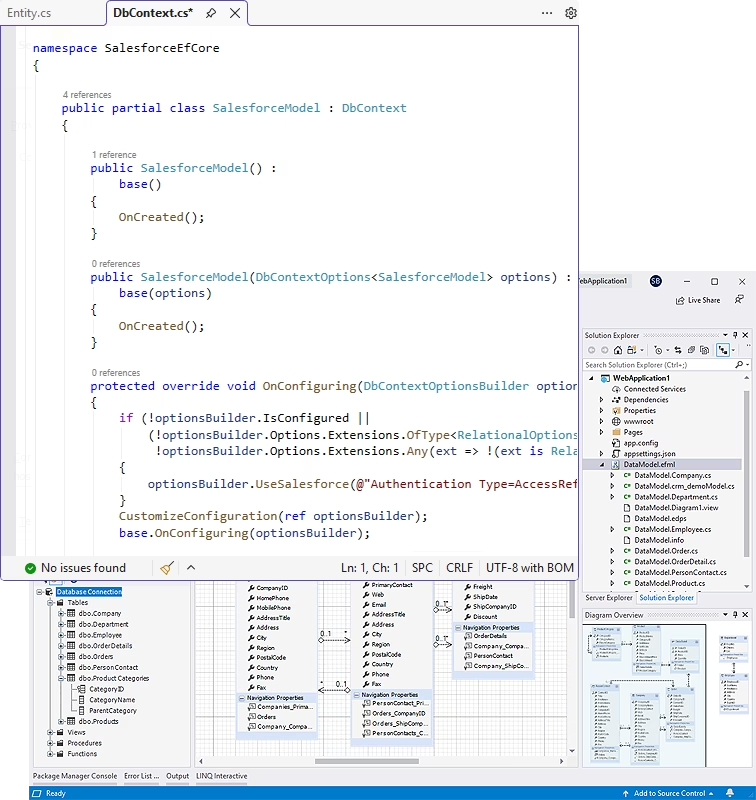
dotConnect for Salesforce provides enhanced Entity Framework support for Salesforce
data with a bundled visual designer for ORM models with Visual Studio integration
- Entity Developer. Standard Visual
Studio Entity Data Model designer is also supported.
SSIS Data Flow Components
dotConnect for Salesforce provides advanced Data Flow components: Devart Salesforce
Source and Devart Salesforce Destination along with Salesforce Connection Manager
for creating Salesforce data integration solutions for data export and import. These
components come with powerful visual editors and offer advanced features:
- Support for SQL and SOQL for querying data
- Visual selecting of Salesforce objects instead of typing their names
- Native bulk protocol for loading data
- Advanced error processing
- Inserting related objects without modifying the database
Read more about SSIS support in dotConnect for Salesforce...
Why Not Web Services API?
Salesforce integration through the free Web Services API has considerable disadvantages.
Before starting you need to learn complex Web Services API, Salesforce data types,
to get acquainted with Salesforce object model. You also need to learn how to choose
protocol, how to establish a connection, and how to retrieve data using query and
querymore calls.
To retrieve data, you have to use SOQL, which is known to be rather limited. Additionally,
the data are returned in an object form that is hard to use in controls, reports,
etc.
Creating a new object is a complex task with the Web Services API, and this webservice
does not allow deleting or updating several objects with a single call - you have
to use cycles for these tasks. All this requires much time and efforts to learn.
With our provider there is no need to learn all of this. You can use your existing
ADO.NET or Entity Framework knowledge to accomplish all the tasks involving Salesforce
data without using their Web Services API.