SQL Server Data Access Components Frequently Asked Questions
Couldn't find the answer to your question?
Take a look at our
support
forum.
Answers
Installation and Deployment
I am having a problem installing
SDAC or compiling SDAC-based projects...
You may be having a compatibility issue that shows up in one
or more of the following forms:
- Get a "Setup has detected already installed DAC packages which
are incompatible with current version" message during SDAC installation.
- Get a "Procedure entry point ... not found in ... " message
when starting IDE.
- Get a "Unit ... was compiled with a different version of
..." message on compilation.
You can have such problems if you installed incompatible SDAC, ODAC,
MyDAC, IBDAC, or UniDAC versions. All these products use common base
packages. The easiest way to avoid the problem is to uninstall all
installed DAC products and then download from our site and install
the last builds.
What software should be installed on the
client computer so that my applications
that use SDAC can run?
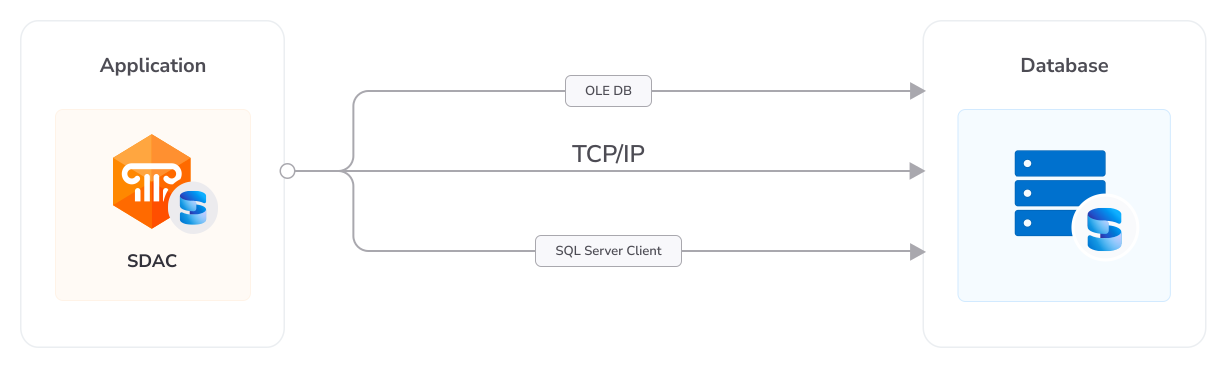
SDAC requires OLE DB installed on the workstation.
In current versions of Microsoft Windows,
such as Windows 2000, OLE DB is already included as part of the
standard installation. But it is highly
recommended to download the latest version (newer than 2.5) of
Microsoft
Data Access Components (MDAC).
Core Lab renaming issue that conserns Delphi for .Net users
-
Please remove all CoreLab assamblies references from your project and add corresponding Devart ones
-
Please change all unit references in uses clauses from CoreLab to Devart (you can use standard renaming tool)
Licensing and Subscriptions
Am I entitled to distribute applications
written with SDAC?
If you have purchased a full version of SDAC, you are entitled to
distribute pre-compiled programs created with its use. You are not
entitled to propagate any components inherited from SDAC or using
SDAC source code. For more information see the License.rtf
file in your SDAC installation directory.
Can I create components using SDAC?
You can create your own components, inherited from SDAC or using
the source code of SDAC. You are entitled to sell and distribute
compiled application executables that use such components, but
not their source code and not the components themselves.
In order to compile components inherited from SDAC, you will
need the SDAC dcp runtime package, which can be received upon
request by registered users
What licensing changes can I expect with
SDAC 4.00?
The basic SDAC license agreement will remain the same. With SDAC
4.00, the SDAC Edition Matrix
will be reorganized and a new SDAC
Subscription Program will be introduced.
What do the SDAC 4.00 Edition Levels
correspond to?
SDAC 4.00 will come in three editions: Standard Edition,
Professional Edition, and Trial Edition. SDAC Professional
Edition can be acquired with Source Code.
When you upgrade to the new version, your edition level
will be automatically updated using the following Edition
Correspondence Table.
Edition Correspondence Table for Upgrading to SDAC 4.00
| Old Edition Level |
New Edition Level |
| - No Correspondence - |
SDAC Standard Edition |
| SDAC Standard Edition |
SDAC Professional Edition |
| SDAC Professional Edition |
SDAC Professional Edition with Sources |
| SDAC Trial Edition | SDAC Trial Edition |
The feature list for each edition can be found here.
I have a registered version of SDAC. Will I need to
pay to upgrade to future versions?
After SDAC 4.00, all upgrades to future versions are free to users
with an active SDAC Subscription.
Users that have a registration for versions of SDAC prior to SDAC 4.00
will have to first upgrade to SDAC 4.00 to jump in on the
Subscription program.
What are the benefits of the SDAC
Subscription Program?
The SDAC Subscription Program
is an annual maintenance and support service
for SDAC users.
Users with a valid SDAC Subscription get the following benefits:
- Access to new versions of SDAC when they are released
- Access to all SDAC updates and bug fixes
- Product support through the SDAC Priority Support program
- Notification of new product versions
Priority Support is an advanced product support program which offers
you expedited individual assistance with SDAC-related questions from the
SDAC developers themselves. Priority Support is carried out over email and
has a two business day response policy.
The SDAC Subscription Program is available for registered users
of SDAC 4.00 and higher.
Can I use my version of SDAC after my
Subscription expires?
Yes, you can. SDAC version licenses are perpetual.
I want a SDAC Subscription! How can I
get one?
An annual SDAC Subscription is included when ordering or upgrading to
any registered (non-Trial) edition of SDAC 4.00 or higher.
You can renew your SDAC Subscription on the SDAC
Ordering Page. For more information, please
contact sales@devart.com.
Does this mean that if I upgrade to SDAC 4
from SDAC 3, I'll get an annual SDAC Subscription for free?
Yes.
How do I upgrade to SDAC 4.00?
To upgrade to SDAC 4.00, you can get a Version Update from
the SDAC Ordering Page. For more information,
please contact sales@devart.com.
Performance
How productive is SDAC?
SDAC uses the lowest documented protocol level (OLE DB) to access
the database server. This allows SDAC to achieve high performance.
From time to time
we compare SDAC with other products, and SDAC always takes first place.
Why does the Locate function work so slowly the
first time I use it?
Locate is performed on the client. So if you had set FetchAll to
False when opening
your dataset, cached only some of the rows on the client, and then
invoked Locate, SDAC will have to
fetch all the remaining rows from the server before performing the
operation. On subsequent calls,
Locate should work much faster.
If the Locate method keeps working slowly on subsequent calls or
you are working with FetchAll=True,
try the following. Perform local sorting by a field that is used in the
Locate method. Just assign
corresponding field name to the IndexFieldNames property.
How To
How can I enable syntax highlighting in SDAC
component editors at design time?
To enable syntax highlighting for SDAC, you should
download and install the freeware
SynEdit component set.
How can I determine which version of SDAC I am using?
You can determine your SDAC version number in several ways:
- During installation of SDAC, consult the SDAC Installer screen.
- After installation, see the history file in your SDAC
installation directiory.
- At design-time, select SQL Server | About SDAC from the main
menu of your IDE.
- At run-time, check the value of the SdacVersion and
DACVersion constants.
How can I stop the cursor from changing to an hour
glass during query execution?
Just set the DBAccess.ChangeCursor variable to False
anywhere in your program.
The cursor will stop changing after this command is executed.
How can I execute a query saved in the
SQLInsert, SQLUpdate,
SQLDelete, or SQLRefresh properties of a SDAC dataset?
The values of these properties are templates for
query statements,
and they cannot be manually executed. Usually there is no need to fill
these properties
because the text of the query is generated automatically.
In special cases, you can set these properties to perform more
complicated processing
during a query. These properties are automatically processed by SDAC
during the execution
of the Post, Delete, or RefreshRecord methods, and are used to construct
the query to
the server. Their values can contain parameters with names of fields
in the underlying
data source, which will be later replaced by appropriate data values.
For example, you can use the SQLInsert template to insert a row into
a query instance as follows.
- Fill the SQLInsert property with the parametrized query template you
want to use.
- Call Insert.
- Initialize field values of the row to insert.
- Call Post.
The value of the SQLInsert property will then be used by SDAC to perform
the last step.
Setting these properties is optional and allows you to automatically
execute additional
SQL statements, add calls to stored procedures and functions, check input
parameters, and/or
store comments during query execution. If these properties are not set, the
SDAC dataset
object will generate the query itself using the appropriate insert, update,
delete, or
refresh record syntax.
How can I get a list of the databases
on the server?
Use the TMSConnection.GetDatabaseNames method.
How can I get a list of the tables list in
a database?
Use the TMSConnection.GetTableNames method.
Some questions about the visual part of SDAC
The following questions usually arise from the same problem:
- I set the Debug property to True but nothing happens!
- While executing a query, the screen cursor does not change
to an hour-glass.
- Even if I have LoginPromp set to True, the connect dialog
does not appear.
To fix this problem, you should add the SdacVcl unit to the uses
clause of your project.
General Questions
I would like to develop an application that works
with SQL Server. Should I use SDAC or DbxSda?
DbxSda is our dbExpress driver for
SQL Server.
dbExpress technology serves for providing a more or less uniform way to
access different servers
(SQL Server, MySQL, Oracle and so on). It is based on drivers that include
server-specific features.
Like any universal tool, in many specialized cases dbExpress providers
lose some functionality.
For example, the dbExpress design-time is quite poor and cannot be expanded.
SDAC is a specialized set of components for SQL Server, which has
advanced server-specific design-time
and a component interface similar to that of BDE.
We tried to include maximal support of SQL Server-specific features in
both DbxSda and SDAC. However,
the nature of dbExpress technology has some insurmountable restrictions. For
example, Unicode fields
cannot be passed from a driver to dbExpress.
SDAC and DbxSda use the same kernel and thus have similar performance.
In some cases dbExpress is
slower because data undergoes additional conversion to correspond to
dbExpress standards.
To summarise, if it is important for you to be able to quickly adapt
your application to a database
server other than SQL Server, it is probably better to use DbxSda. In other
cases, especially when migrating
from BDE or ADO, you should use SDAC.
What are the advantages of SDAC over Delphi ADO
components for accessing SQL Server?
ADO is a universal data access technology, while SDAC is
specialized for Microsoft SQL Server,
so SDAC includes many server-specific features which ADO components do not
implement. SDAC has much better performance
(5-10 times in different tests) because it works directly through OLE DB.
Moreover, SDAC has advanced design-time support.
Behaviour of my application has changed when I
upgraded SDAC. How can I restore the old
behaviour with the new version?
We always try to keep SDAC compatible with previous
versions, but sometimes we have to change
behaviour of SDAC in order to enhance its functionality, or avoid bugs.
If either of changes is undesirable for
your application, and you want to save the old behaviour, please refer
to the "Compatibility with previous
versions" topic in SDAC help. This topic describes such changes, and
how to revert to the old SDAC behaviour.
On connect I get error "OLE DB error occured.
Code 800401F0h. CoInitialize has
not been called." What can I do?
As SDAC uses OLE DB, before a new connection is established
it is necessary to
initialize OLE by calling CoInitialize. In common case VCL does it
automatically. SDAC does
not call to the CoInitialize and CoUninitialize functions itself as
it may cause unexpected
problems if OLE is used in the program by someone else.
Are the SDAC connection components
thread-safe?
Yes, SDAC is thread-safe, but there is a restriction.
The same TMSConnection object cannot be used in several threads at the
same time. So if you have a multithreaded application, you should have
a TMSConnection object for each thread that uses SDAC.
When editing a DataSet, I get an exception
with the message 'Update failed.
Found %d records.' or 'Refresh failed. Found %d records.'
This error occurs when the database server is
unable to determine which record
to modify or delete. In other words, there are either more than one
record or no records that suit
the UPDATE criteria. Such situation can happen when you omit the
unique field in a SELECT statement
(TCustomDADataSet.SQL) or when another user modifies the table
simultaneously. This exception can
be suppressed. Refer to TCustomDADataSet.Options topic in SDAC
help for more information.
Some questions with using
TCustomDADataSet.FetchAll=False mode
Common issues when using FetchAll=False:
- I have problems working with temporary tables.
- I have problems working with transactions.
- Sometimes my application hangs on applying changes to database.
Usage of FetchAll=False mode has many advantages; however, it
also has some restrictions
since it requires an additional connection to server to be created
for data fetching. The
additional connection is created to prevent the main connection
from blocking.
These problems can be avoided by setting the FetchAll property
to True. Please see description of the
FetchAll propery and the CreateConnection option in SDAC help for
more information.
One more way to solve these problems is to use the Multiple
Active Result Sets (MARS) feature.
This feature lets you keep more than one unfetched record set
within a single connection.
To enable MARS, set the MultipleActiveResultSets option of
TMSConnection to True.
Note: To use MARS, you will need to have SQL Server 2005 and
SQL Native Client installed.