Connect to traditional databases and cloud-based services from Power BI using an ODBC driver directly. No need to use client software to establish a Power BI ODBC connection and fetch your data.
Access diverse data stores with mapping of data source-specific SQL data types to the standard ODBC data types. You can create custom mappings between data source fields and ODBC data types.
Devart ODBC drivers use SSL / SSH and HTTPS tunneling to protect user data in transition. Tunneling allows you to send communications securely between machines.
Devart ODBC drivers resolve the major challenge of retrieving data from various cloud applications into Power BI: the lack of adequate API support for SQL-92 standard SQL commands.
Unicode is the universal standard for encoding characters in most languages. The drivers for Power BI service with ODBC connection provide a Unicode-compliant way to work with strings and characters in databases: they can map Unicode function calls and string data types to ANSI encoding.
Our ODBC drivers can be used to interact and perform SQL CRUD operations on popular traditional databases and cloud services from Power BI, such as MySQL, Oracle, PostgreSQL, Salesforce, or Mailchimp.
We frequently release new versions of ODBC drivers with new capabilities or enhancements for already existing features. Every Power BI ODBC driver download contains all changes and new features based on customer feedback. Bug fixes and minor improvements are released as nightly builds to resolve issues timely.
Our ODBC drivers provide full support for the standard Open Database Connectivity API functions and data types. The ODBC interface enables Power BI to access databases by using standard SQL. Additionally, we have designed Advanced Connection String parameters that implement different types of behavior.
Our Power BI ODBC drivers allow you to perform bulk record update in Power BI in a single update statement while maintaining decent update speed. When you need to update a table with a million of records, you can use a single update operation which significantly reduces execution time compared to row-by-row operations.
Contact our friendly, knowledgeable support team for assistance if you have any questions about using our ODBC drivers with Tableau or join our forum to discuss anything related to the database application development with other professional developers.
Yes. Power BI supports ODBC data sources, allowing you to import data from different platforms through ODBC for transformation and analysis.
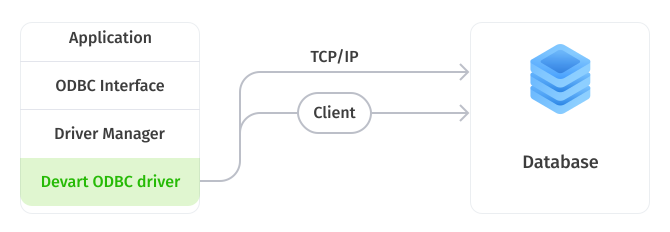
You can use ODBC providers such as Devart's ODBC connector for Power BI. This makes it easy to connect directly to databases and cloud platforms, letting you load full tables or run SQL queries to bring in specific data.
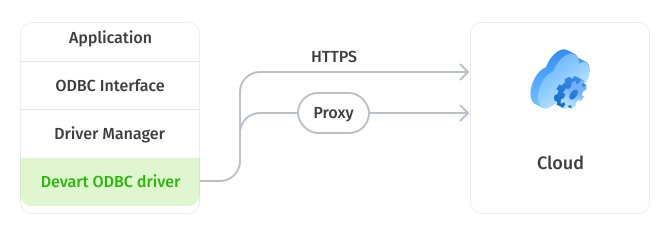
Yes. You can run SQL queries directly against your ODBC data source in Power BI. This allows you to filter and retrieve only the data you need, just like working with a regular SQL database.
That depends on the connector you use. For example, the ODBC connector for Power BI supports over 90 data sources, including major databases, CRMs, and cloud platforms.
The ODBC connectors by Devart offer the option of refreshing data in Power BI automatically, with one click. Therefore, always have the latest data.
Devart's ODBC drivers for Power BI are powerful yet easy to use. Devart provides both 32-bit and 64-bit versions of its ODBC drivers, the setup takes just a few clicks. The ODBC connection string for Power BI is straightforward, and you can connect to more than 90 data sources, including databases and cloud platforms (e.g., Salesforce, Zoho, FreshBooks, and many more). They support advanced SQL queries with JOINs, giving you full control over the data you import. Free trial versions are also available so you can test all features before committing.
This usually happens if the connection is misconfigured. Double-check your Power BI ODBC connection string to ensure all details are correct. Also, confirm that your data source allows connections from third-party tools like Power BI and that your user account has access to all required data. If restrictions exist, you’ll need to adjust permissions on the data source side.