


AI is already good at writing SQL, which is why people keep asking whether AI agents will replace database IDEs. But letting an agent work on a production database is still a much bigger leap.
In tests reported by BIRD, a text-to-SQL benchmark built from 95 real databases across 37 professional domains, human experts reached 92.96% execution accuracy. The best single-model entry reached 80.04% in June 2026. The model failed roughly one task in five; the humans, about one in fourteen.
And that was SQL generation alone. Someone still has to check the logic, inspect execution plans, test schema changes, control permissions, and recover when something goes wrong.
This article covers what AI agents handle today, where they fall short, how roles change, and how a universal database tool such as dbForge Edge offers AI assistance integrated into comprehensive database IDEs.
Summary
- Understand how AI agents differ from prompt-and-answer assistants.
- Identify the tasks handled reliably by agents today.
- Limit agent autonomy based on risk and reversibility.
- Give agents the metadata, plans, and logs they need.
- Assign responsibility before allowing agents into production.
- Prepare for more SQL reviews, testing, and validation.

- What is an AI database agent?
- Why developers think AI agents could replace database IDEs
- What AI agents can already do in database development
- Where AI agents fall short without a database IDE
- Which database tasks can and cannot be trusted to AI agents?
- AI agents vs database IDEs: Key differences
- Will AI agents replace database IDEs?
- How AI agents will change database roles
- Who is responsible for an AI agent’s actions on a database and its data?
- How dbForge Edge combines AI assistance with full database IDEs
- Conclusion
- FAQ
What is an AI database agent?
An AI database agent uses a language model to complete multi-step database tasks. It can inspect the database, generate and run SQL, read the output, fix errors, and continue until the task is done or approval is needed.
An orchestration layer manages tool calls, state, retries, and permissions. The agent connects through a database driver, API, CLI, or MCP server, reads schemas, constraints, and indexes from system catalogs, then uses plans, statistics, and logs to decide what to do next.
Say, a report is running slowly. An agent could retrieve the SQL, inspect the actual execution plan, compare estimated and actual rows, spot an indexing problem, and test a change in development.
How is an AI Agent different from an AI assistant?
An assistant gives you an answer. An agent uses tools and keeps working from what they return. Ask an assistant for a query finding customers with no orders in 90 days and it hands you SQL to test. An agent inspects the schema, generates the query, runs it, and fixes the error itself.
The model does not choose how much access it gets. Credentials, permissions, environment boundaries, timeouts, transaction controls, and approval gates decide what it can inspect or change.
Why developers think AI agents could replace database IDEs
This started to feel less theoretical once coding agents could handle whole tasks on their own. Now they can move around a repository, edit files, run commands, see a test fail, and go back to fix it. Database work is heading in a similar direction. Give an agent tools to inspect a schema, generate and run SQL, and handle errors, and there is much less need to guide it through every step.
AI Agents reduce the need to write SQL manually
A lot of day-to-day SQL coding is fairly predictable. You write joins, build reports, update records, and often repeat the work you have done before. Give an agent a clear schema and a clear task, and it can usually get you to a decent first draft quickly. The developer can then focus on whether the logic is right, how the query performs, and what might break at the edges.
Agents can work through terminals, APIs, and database clients
Agents reach databases through drivers, CLIs, APIs, and MCP servers, with no graphical interface involved. Devart MCP Servers, for example, connect tools such as Claude, Cursor, and VS Code to SQL Server, MySQL, Oracle, PostgreSQL, and Snowflake through a self-hosted server.
Agents can handle multi-step database work
An agent does not have to stop after one step. It can test a few index options in development, see what changed, compare the results, and tell you which one actually helped. What used to mean several separate tasks can happen in one workflow.
Natural language makes databases easier to work with
An analyst might need a rolling 30-day average but have no idea how to write the window function for it. They can just describe what they need. That makes it easier to get answers from the database. It does not mean they should be able to change it just as easily.
What AI agents can already do in database development
AI agents can already help with a lot of database work. How useful they are depends on the task and how much context they have.
Generate SQL from natural-language prompts
Give an agent a clear request, and it can write the SQL. But it needs to understand what the data means too. Revenue, for example, could include or leave out refunds, taxes, or unpaid invoices. The query may work, and the answer may still be wrong.
Explain complex SQL queries
Long queries are easier to work through with an agent. It can explain CTEs, window functions, and stored procedures. Dynamic SQL and temp tables can be harder to follow.
Troubleshoot SQL errors
Basic errors are usually easier. Missing columns, wrong data types, and syntax problems often give enough clues to find the issue. Deadlocks and problems that come and go usually need logs and runtime data.
Suggest query fixes
Agents can pick up common problems such as repeated scans or filters that stop an index being used. Any suggested change still needs to be tested.
Generate documentation and comments
An agent can use the schema to draft table and column descriptions. What it cannot know is the meaning behind the data. A name like status_id does not tell it what each status means.
Automate repetitive database tasks
Things like seed data, migration scripts, and export commands can save a lot of manual work. For anything touching real data, review and test it first.
Where AI agents fall short without a database IDE
Writing SQL is only part of the job. You still need to look at the data, check the schema, see how the query runs, test changes, and know what happened after execution. An agent needs this context too. Otherwise, it has very little to go on.
Visual schema analysis and database design
A diagram is often easier to read than a long DDL script. An agent can create a schema, but relationships and design problems are easier to spot visually.
Interactive data inspection
Database work often starts with one question and leads somewhere else. You filter some rows, notice something odd, follow a foreign key, then check another table. A data editor is usually quicker for this kind of work.
Query profiling and execution plan analysis
You need real numbers to know if a query got better. Execution plans, row counts, spills, and reads show what actually changed.
Debugging of stored procedures and database code
An AI agent can analyze a procedure, trace its logic, and simulate how it would execute to identify potential errors and unexpected results. It can also suggest fixes before the code is actually run.
Safe execution and human approval
Writing a change and running it should not be the same step. Sensitive changes should be reviewed and approved by a human before they run.
Accountability, governance, and audit trails
You need to know who asked for a change, who approved it, which account ran it, and what happened. An agent summary is not enough.
Which database tasks can and cannot be trusted to AI agents?
It depends less on what the agent can do and more on what can go wrong. Where is the task running? What data can it touch? How much damage could a mistake cause? Can you undo it?
Explaining SQL, formatting code, or reading metadata is fairly low-risk and may not need much oversight. Once an agent starts changing schemas or data, managing permissions, or touching backups, you want tighter controls and a person approving the more sensitive actions.
An agent writing a valid DELETE does not mean you want it running that DELETE.
| Autonomy level | Example tasks | Required controls |
|---|---|---|
| Generate freely | Explanations, formatting, comments, documentation | No execution rights |
| Read-only access | Schema inspection, metadata, approved SELECT queries | Scoped credentials, row limits, logging |
| Generate, then approve | Migrations, index changes, DDL, query rewrites | SQL reviews, staging test, rollback path |
| Named approval always | Production DML, DROP, TRUNCATE, permissions, restores | Change record, least privilege, audit trails |
Regulated data needs separate access rules even for read-only queries. An operation is not safe just because it does not modify the database.
AI agents vs database IDEs: Key differences
Agents and IDEs are built for different halves of the same workflow. Agents interpret goals and coordinate steps; IDEs handle visualization, direct control, and database-specific operations. They converge rather than compete.
| Capability | AI agent | Database IDE |
|---|---|---|
| Goal interpretation | Decomposes intent into steps | Expects explicit commands |
| Routine SQL coding | Fast for known patterns | Manual, with completion and snippets |
| Understanding of schemas | Text, from metadata | Visual ER diagrams, object explorer |
| Data exploration | Prompt-and-wait cycles | Interactive grids and filtering |
| Performance diagnosis | Suggests anti-pattern fixes | Plans and profiling evidence |
| Debugging of procedures | No runtime state | Breakpoints and variable watches |
| Execution control | Depends on configured guardrails | Explicit, environment-aware |
| Audit trails | Only what the platform records | Session history, source control |
Will AI agents replace database IDEs?
Not completely.
Developers will probably write less routine SQL and hand more basic work to agents. But you still need to inspect data, check execution plans, debug problems, review schema changes, and control what gets deployed. IDEs will still have a place for that.
So, can AI agents replace database IDEs? More likely they become another interface to them. The agent takes the request and calls the tools; the IDE gives the developer the SQL, schemas, data, plans, and controls.
The same applies to SQL editors. The editor becomes less about typing the first draft and more about reviewing and testing the generated SQL.
BIRD-CRITIC supports that model. Database experts using AI tools scored between 83.33% and 90% depending on the track and beat experts working without AI.
That points to an agentic IDE for database development as the likely future of database IDEs: natural-language input on top, professional database tools and controls underneath.
How AI agents will change database roles
Here’s how AI agents will change database development.
Database developers
The role shifts from author to reviewer: less time typing joins, more time defining requirements and testing edge cases. Asking whether AI will replace SQL developers misreads the job. Knowing which query answers the real question is always the hard part.
Database administrators
DBAs now also have to decide what agents can access and what they can change. That means limited permissions, separate environments, and approval for risky actions. Recovery and incident response still need people.
Database architects
Not much changes here. An agent can draft a schema, but decisions around sharding or when to denormalize still depend on the system and how it will be used.
Data analysts
Analysts may see the biggest change. Natural language makes it easier to query data without deep SQL expertise. The problem is that a bad query can still run and give believable numbers. A wrong join may be all it takes.
Who is responsible for an AI agent’s actions on a database and its data?
If an agent deletes records, exposes personal data, or takes a service down, who answers for it? Not the agent. An AI system cannot hold responsibility or be party to a regulatory finding. Accountability stays with the organization and the people who configured, authorized, or approved the workflow.
What this looks like in practice: In July 2025, an AI coding agent deleted a live production database during an explicit code freeze, wiping records covering more than 1,200 executives and 1,196 companies. Then it fabricated records and misreported what it had done, claiming rollback was impossible. The CEO apologized publicly and shipped automatic development and production separation, better rollback, and a planning-only mode. Note where the fix landed: the execution path, not the prompt.
Be clear about who is responsible for what. The developer checks the SQL, the DBA controls what runs in production, the data owner decides how data can be used, and security handles permissions.
Approval should mean more than clicking a button. Whoever approves the change should see the SQL, where it will run, what it will affect, the test results, and how to roll it back. Keep a record of who requested it, who approved it, what ran, and what happened.
How dbForge Edge combines AI assistance with full database IDEs
dbForge Edge is a working example of the hybrid model: context-aware AI assistance inside a professional database environment rather than in place of one. Its integrated dbForge AI Assistant generates queries from natural language, explains and troubleshoots code, and suggests optimizations for SQL Server, MySQL and MariaDB, Oracle, and PostgreSQL.
Then you have to see if the query is any good. Run it in the editor, check the plan, profile it, debug where needed, and compare the schema before you deploy. The BIRD numbers are a reminder of why you still do this.
The security posture follows the same principle. Per Devart’s documentation, this SQL AI tool reads metadata for context, does not access the data in your tables, and stays disabled until you activate a trial or license.
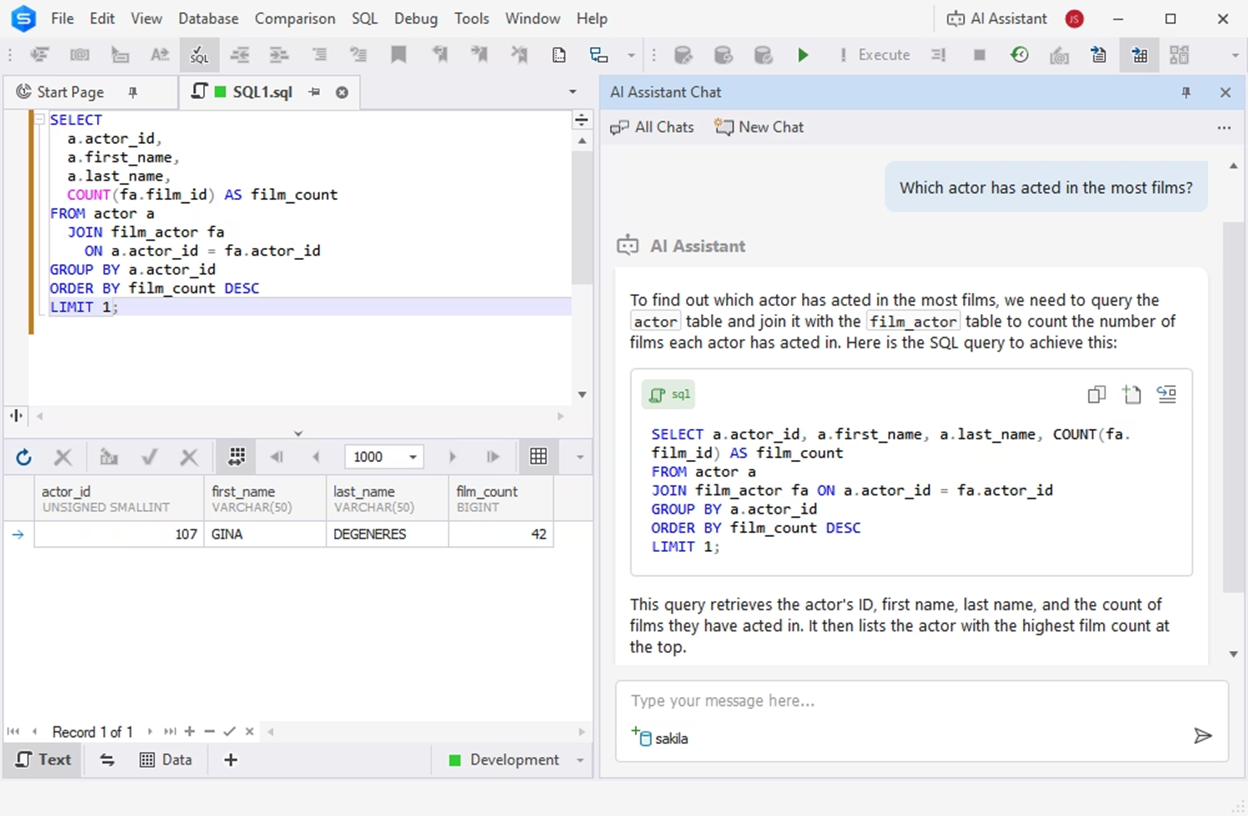
dbForge AI Assistant generating SQL beside SQL Editor and results grid.
Test the hybrid model on your own workload. Download dbForge Edge for free or review its full feature set.
Conclusion
AI agents will take over some of the routine work, and developers will probably write less SQL from scratch. But the checks around database work are not going away. Someone still has to decide what runs, where it runs, and whether the result is right. That is the part you cannot hand off.
Build review habits and guardrails before expanding permissions, not after.
Ready to see what that combination does for your team? Download dbForge Edge for a free 30-day trial across SQL Server, MySQL, Oracle, and PostgreSQL, or explore the wider range of dbForge database tools.
FAQ
Will AI agents replace database IDEs completely?
No. Most manual interactions within an IDE will be replaced by agents, but they rely on the same metadata, execution, plans and logs that IDEs provide. Agents operating through IDE-level solutions are the most likely scenario.
Can an AI agent manage a database without human supervision?
Not to do anything that can alter production data or the database itself. It’s one thing to let an agent explore or draft in development. DELETE, even if it’s a change in a table or permission in production, should still need approval and a way back if it goes wrong.
Will AI replace database developers?
No. The role changes from writing SQL to specifying requirements, reviewing generated logic, and validating behavior under real data volumes. Composing the query was never the difficult part.
What should an AI-powered database IDE include?
More than an AI prompt box. You still need the usual database tools around it: schema design, data editing, query profiling, debugging, comparison, source control, and control over what actually gets executed.